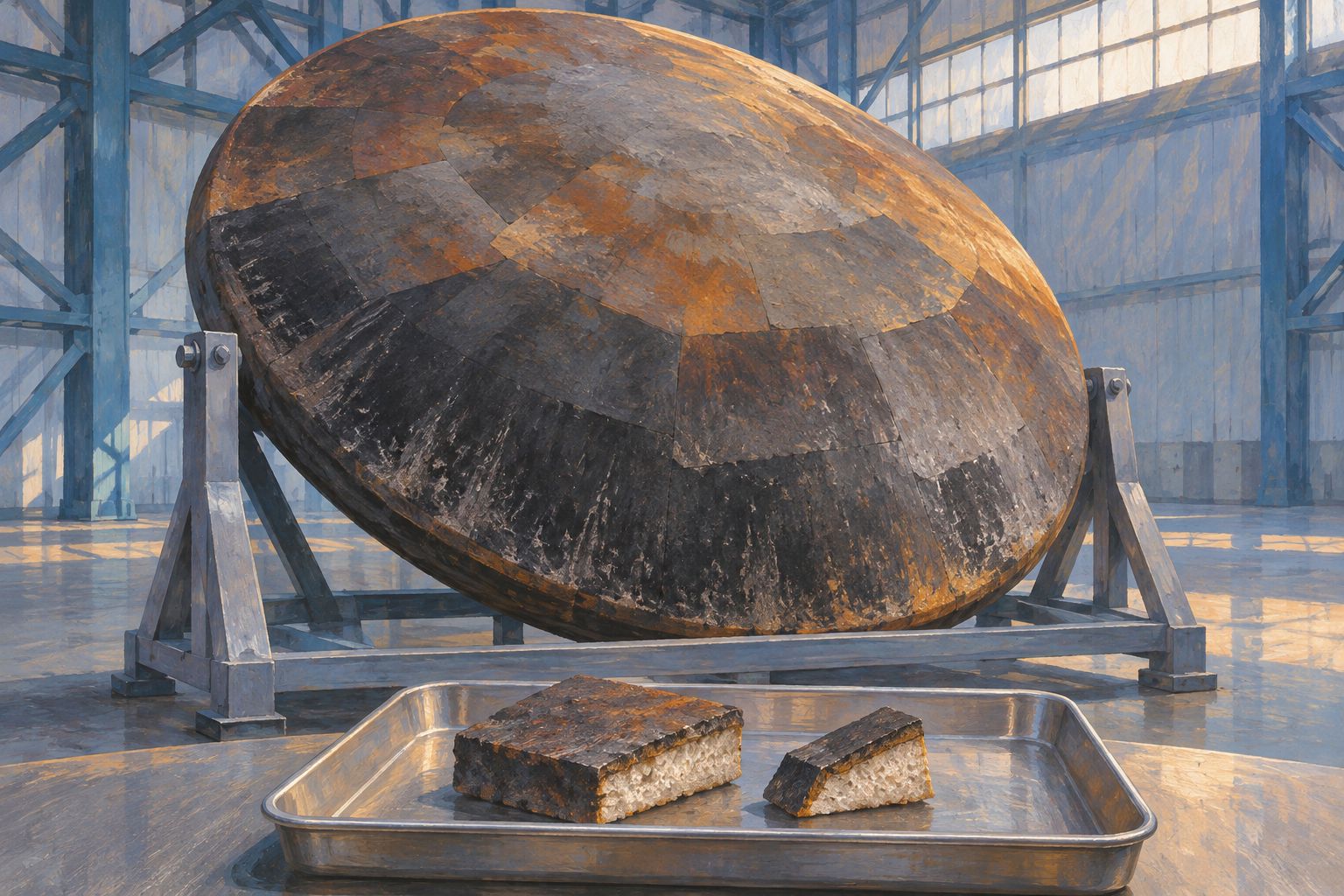
On April 10, 2026, U.S. Navy divers photographed the underside of Orion after Artemis II splashed down in the Pacific. Four astronauts had returned from their journey around the Moon. Beneath the capsule was a surface that engineers still needed to read.
The first inspections were encouraging. They were also the beginning of another examination. An earlier Orion had come home safely with damage that its ground tests had not adequately anticipated.
The new mission would test more than a spacecraft. It would test an explanation of what had happened to the old one.
What a safe return left unanswered
Artemis I had been uncrewed. After its December 2022 return, inspectors found unexpected loss of charred material from the heat shield. Material designed to protect the vehicle through ablation had broken away in places differently from what engineers expected.
The distinction mattered. A heat shield is supposed to change as it does its work. The question was whether the observed change was understood well enough to support the next flight, which would carry people.
NASA’s Office of Inspector General examined that problem in its May 2024 readiness audit. It identified heat-shield behavior among significant crew-safety risks and recommended that the cause be understood before Artemis II launched. The report also raised a wider problem: missed imagery, recovery and telemetry opportunities had limited what NASA could learn from its first test flight.
A test campaign depends on the evidence it can recover. Sending a vehicle through the right environment is only part of the work. The organization must be able to discover what the environment did to it.
Hotter was not the same as truer
The investigation found a complication in the relationship between a demanding test and a representative one.
NASA’s December 2024 explanation described gases building up inside Avcoat, the shield’s protective material. They could not escape adequately, and pressure produced cracking and loss of char. The timing of heating during Artemis I’s atmospheric skip was important to that behavior.
Earlier ground tests had used higher heating rates. Those conditions allowed a permeable char layer to form and release gas. The less severe heating during part of the actual flight produced a different material response. Enhancements to the arc jet facility subsequently helped reproduce the flight behavior on the ground.
The work had to change the test’s relationship to reality. Increasing a stress value was not, by itself, a guarantee that the relevant behavior would appear.
That is a consequential distinction for any organization that relies on rehearsals, simulations or pilot programs. A difficult exercise can be executed impeccably while leaving the decisive condition unexamined. Confidence then rests on something the exercise did not establish.
The leadership obligation is to ask what the test represents. Which conditions does it reproduce? Which interactions does it leave out? What would make a good result less transferable than it first appears?
Those questions require contact with the work and with the people who understand its limits. They also require enough discipline to revise a familiar method when the evidence exposes its weakness.
Making the explanation examinable
The investigation involved more than a single specialist finding the answer. NASA’s Engineering and Safety Center described a team drawn from inside and outside the agency, supporting material tests, analysis, inspection and review. Its contribution included methods for examining the shield without destroying it and work to assess possible causes systematically.
NASA also convened an independent technical review of the investigation. The agency reported that the reviewers agreed with its finding about the cause. That agreement followed an examination of evidence and analysis.
In PCOCI, Credibility is warranted confidence in judgment, competence and consistency. Here, the useful evidence is the work that made an engineering judgment available for examination: a behavior reproduced, an explanation tested and a review that could assess the connection.
Such confidence attaches to a particular claim and its supporting conditions. It should help a decision-maker understand what can responsibly be inferred, including where the inference ends.
For Artemis II, NASA retained the installed shield and changed the entry trajectory. The revised approach limited time in the conditions associated with the earlier problem. A 2026 technical abstract by the investigation team describes that operational change alongside a separate material correction for subsequent missions.
These were different responses to the same investigation. The flight approach addressed the coming mission. Production work would change what later missions inherited.
The result meets the prediction
After the April 2026 return, NASA’s initial account reported substantially less char loss and behavior consistent with its revised ground testing. It also described further inspection and analysis still to come.
The sequence of reporting matters. The first photographs could show an encouraging condition. Detailed comparison could then ask whether that condition matched the engineering prediction.
In its October assessment, NASA reported nine locations of char loss on the Artemis II shield, compared with 103 on Artemis I. Its post-flight review found the thermal protection performance consistent with pre-flight analysis and testing. Sample extraction, scanning and material assessment continued.
The published result supports a specific conclusion about the changed approach on that flight. It does not settle every future operating condition or turn the heat-shield assessment into a verdict on the entire Artemis program.
A useful feedback loop preserves that precision. The organization identifies what it expected, compares the observed result and retains the information needed to investigate a difference. The result can strengthen confidence without ending scrutiny.
What the next test inherits
By autumn 2026, the investigation had reached beyond analysis of one returned object. NASA reported that later Avcoat production had been changed for more consistent permeability, and that the Artemis III shield had been installed. That hardware’s flight performance remained to be demonstrated.
The broader accomplishment includes a changed capacity to investigate: more representative ground testing, methods for inspecting returned material, technical review and a connection from findings to production. Those capabilities give future teams methods for examining a new anomaly and deciding what its consequences require.
For PCOCI, that is where Improvement becomes an organizational question. A better measured result matters. Sustained Improvement also needs methods and routines that keep producing usable evidence after the immediate problem loses attention.
The earlier inspector general’s concern about missing data shows why this work extends beyond analysis. Images have to be obtained. Hardware has to be recovered. Data must remain interpretable. A team cannot exercise judgment over evidence it never receives.
The same principle applies to less dramatic work. A pilot service can meet its headline target while concealing the extra burden on another team. A system can pass a load test whose traffic pattern differs from real use. The relevant improvement includes changing what the organization can detect, explain and carry into the next decision.
Artemis II offers an especially concrete version of that obligation. A successful return supplied another object to inspect and another prediction to examine. The learning resides in the continuing work that connects those two things.