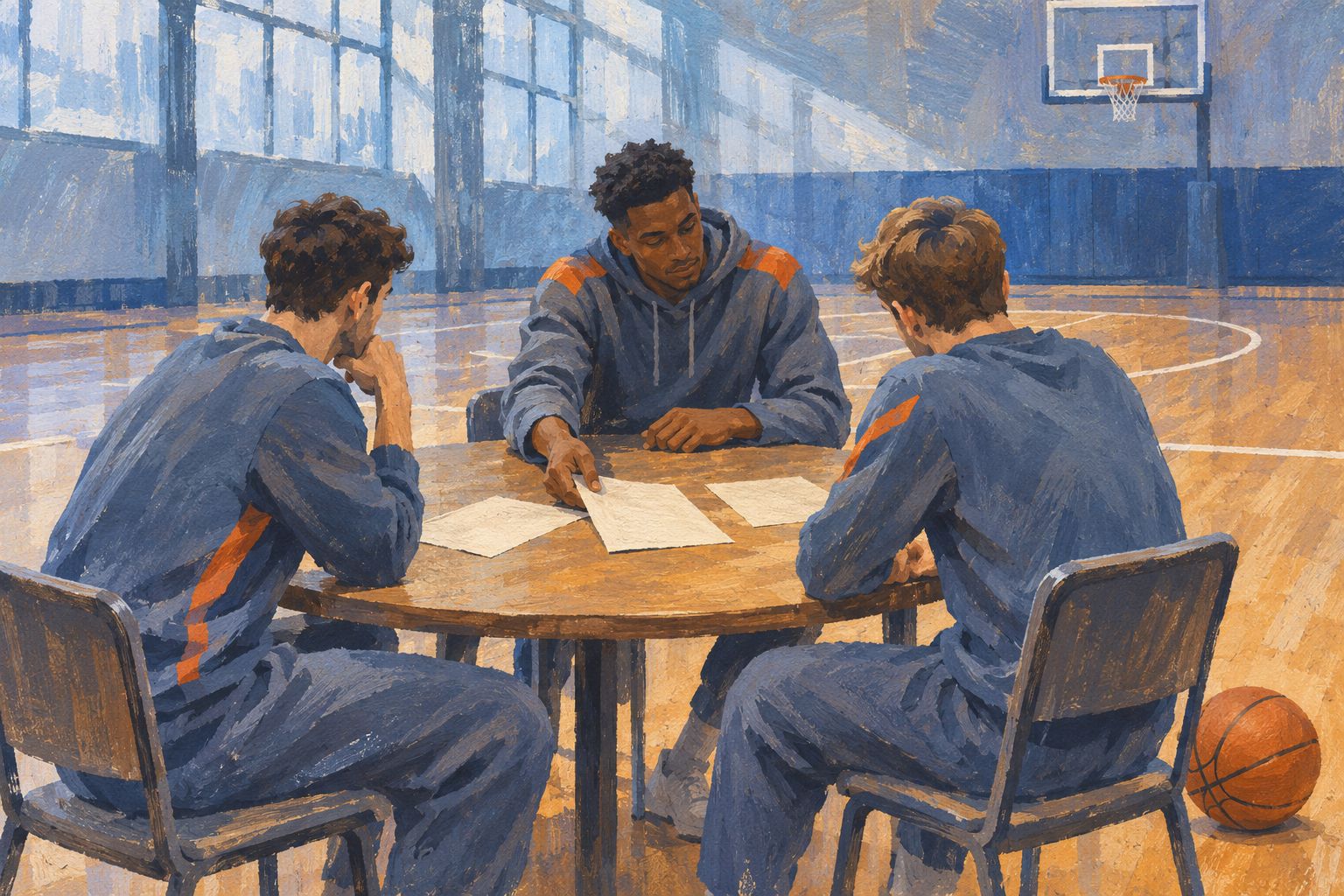
On September 30, three Tennessee basketball players brought a proposal back to their teammates. They had spent months working through questions that reached well beyond a game: compensation, health, time, education and the rules governing an athlete’s future.
The players were Tyler Lundblade, Campbell Duncan and DeWayne Brown II. Their teammates had elected them as representatives. Now those teammates had to be able to examine the work done in their name.
The return meeting sits inside a larger public event. On November 10, 2026, the players and Athletes.org released a proposed collective bargaining term sheet. It described possible arrangements for college athletes and the institutions around them. It also exposed the work that has to happen before a group can speak through a few people without disappearing from the conversation.
A team chooses people to speak
Athletes.org, an organization seeking to represent college athletes, helped the Tennessee players develop their positions. Its account describes months of meetings in which the representatives considered the subjects affecting their experience, debated positions and worked toward proposals they wanted carried to athletics leadership.
The distinction between having an opinion and representing a team became practical. The representatives were dealing with questions that affected an entire roster. A proposal about compensation could have consequences for players at different stages of their careers. A rule about time would reach into the hours available for study, family or other opportunities.
No single playing experience could settle all of those questions. The work required a view of the team broad enough to include people whose immediate interests might differ.
This is one difficulty that election leaves in the elected person’s hands. Selection establishes who may speak for the group. The quality of that representation depends on what the person continues to carry into the discussion: whose circumstances remain visible, which consequences get examined, and whether others can still influence the position being advanced.
The three players had help. Athletes.org supplied an organizing structure and worked with them on the proposed terms. The representatives’ responsibility operated within that shared process. The outcome was a set of positions that could be taken into discussion, rather than a collection of individual reactions left beside one another.
Interests become a working document
The proposal’s subjects reveal the scale of the task. Its published summary groups matters of money, player movement, health, time, enforcement and academic support into one document.
These subjects touch different parts of an athlete’s life. Compensation concerns the immediate return for the work. Health provisions reach toward what happens when the body can no longer perform that work. Time commitments affect the space available for an education and a life beyond the sport. Enforcement determines what a promise might mean when someone believes it has been broken.
Putting them together makes a leadership problem visible. A satisfactory answer in one area may leave a consequential dependency elsewhere. A financial promise can be undermined by an unclear obligation. Protected time has limited value if the people concerned cannot establish when it applies. A process for raising a concern needs someone with a defined responsibility to respond.
The proposed spending floor alongside a salary cap illustrates the effort to address more than one interest within a rule. A ceiling concerns a limit on spending. A floor asks what minimum commitment would accompany it. The public draft also includes an independent grievance process, bringing the question of how disputes would be handled into the same discussion as the proposed benefits and restrictions.
These remain proposals. Their relevance to leadership lies partly in the questions they make examinable. General agreement that athletes should have a voice becomes more demanding when the voice must describe workable obligations, limits and ways to contest a decision.
The discussion has to travel back
According to Athletes.org, the players and the organization brought their positions to athletics leadership, including athletics director Danny White. Multiple rounds of discussion followed. The organization reports that administrators raised concerns and operational questions. Front Office Sports separately describes the representatives bringing a revised proposal back to the team on September 30.
That return matters because discussion changes the material being represented. A representative can enter with one formulation and encounter a constraint, objection or possibility that alters it. The people who gave the representative a mandate still need access to what has changed.
Otherwise, the distance between the group and its representative can grow during the very process intended to give the group influence. The person at the meeting knows the reasons behind a revision. Those outside it may see only the finished wording and the assurance that it is in their interests.
Returning makes that gap available for scrutiny. It creates another occasion to explain the proposal and hear what it would mean for the people expected to live with it. It also keeps representation connected to a group whose concerns cannot be permanently captured in an initial election.
This is the part of the Tennessee story that gives Ownership a concrete shape. The representatives’ involvement continued across preparation, discussion with leadership and review with teammates. Their role carried a responsibility beyond contributing an idea or attending an appointment. They were working on terms intended to affect others, and bringing that work back to those others.
Participation has an honest boundary
Public attention can make a promising exercise look more complete than it is. The primary term-sheet page draws an explicit boundary: Tennessee’s administration participated and provided perspective, but has not agreed to or endorsed the terms. The document represents no university commitment, policy or binding legal position.
As checked on November 18, the proposal is not a signed agreement or a ratified collective bargaining agreement. The discussions do not establish that the proposed protections are now available to players. Nor does publication settle how such an arrangement would ultimately be negotiated, implemented or maintained.
That boundary belongs inside the story. It identifies the actual accomplishment: elected representatives developed a position, engaged institutional leadership and made a proposal available for examination. It leaves the unfinished work visible.
In PCOCI terms, Ownership can be substantive while the authority needed to deliver an outcome remains unresolved. Carrying consequences does not confer unlimited decision rights. A representative cannot make an institution’s commitment by wishing it into a draft, and institutional participation does not automatically establish meaningful Control over the proposed arrangement.
Improvement remains the destination. The next evidence would have to concern what becomes operative, how responsibilities are coordinated, how concerns are addressed and whether the resulting work can be sustained. A proposal gives those questions a place to begin. It cannot supply their answers in advance.
For leaders elsewhere, the practical demand is already recognizable. Representation needs a continuing relationship with the people whose interests travel into the room. The obligation grows as discussion becomes more detailed, because each revision can redistribute an effect that those people will eventually carry.