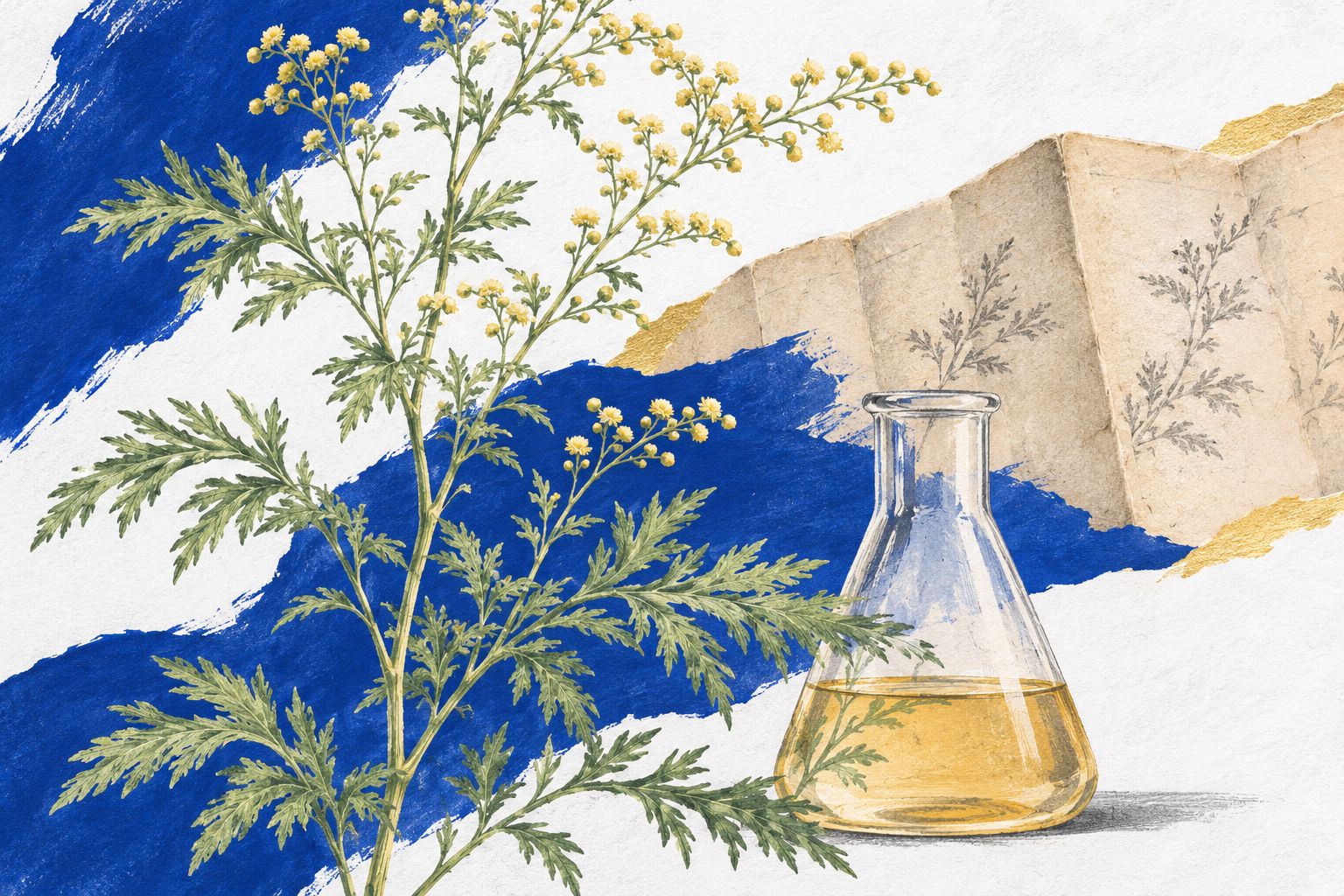
Tu Youyou had a promising malaria extract. What she did not have was a result she could reliably reproduce.
By 1971, the search had already consumed years of work. Existing antimalarial drugs were losing ground to resistance. In China, Tu’s research group was investigating medicinal plants for Project 523, a national effort to find new treatments. Hundreds of extracts had passed through the search. Qinghao offered a lead, then inconsistent results.
A plant associated with treating fever might contain something valuable. The laboratory’s way of preparing it might also be losing that value.
Tu returned to an old medical handbook. Its author, the fourth-century physician Ge Hong, described soaking qinghao and wringing out the juice. The preparation omitted a familiar step: boiling.
The clue was small enough to overlook. Following it would change the experiment. A useful medicine was still a long way off.
A national search, a particular responsibility
Project 523 took its name from May 23, 1967. China had organized the effort amid the malaria emergency of the Vietnam War, following a request from North Vietnam for help against drug-resistant disease. The search brought together researchers across institutions and disciplines. Some investigated synthetic compounds. Others examined the possibilities in traditional medicine.
In 1969, Tu was appointed to lead the research group at the Institute of Chinese Materia Medica. Her responsibility was one part of this larger program. Trained in pharmacy and in Chinese medicine, she worked at the intersection the search required: inherited medical knowledge on one side, experimental investigation on the other.
She gathered remedies from texts and practitioners, examining more than 2,000 preparations. A collection of 640 prescriptions was circulated through the national project office in April 1969. Before there was a successful drug candidate, there was already work to make possible leads available beyond a single investigator.
The screening was demanding. The Lasker Foundation’s account records 380 extracts from 200 herbs by 1971. An entry in a medical text was a place to begin. Each candidate still had to yield material whose activity could be tested.
Qinghao, Artemisia annua, presented an especially difficult kind of promise. It showed activity, but inconsistently. The preparation itself became a question worth reopening.
The instruction that changed the experiment
In her 2011 account in Nature Medicine, Tu traced the turning point to Ge Hong’s handbook. The instruction suggested that heat might be damaging the active ingredients. She changed the extraction method, using ether at a lower temperature, and removed the acidic portion of the extract.
The neutral portion became the crucial material. Her Nobel lecture dates the decisive rodent experiment to October 4, 1971. Tests in monkeys followed in December and January.
The old instruction had led to a new experimental direction. A promising but erratic preparation was giving way to material that supported further investigation. The difference was tangible: researchers had something more definite to work with than the reputation of a plant.
That progress created a new question. What would happen when the finding left Tu’s laboratory?
Evidence other researchers could work with
On March 8, 1972, Tu reported the animal results at a national Project 523 meeting in Nanjing. The national office had brought researchers together to exchange findings. A result produced within one institute was now available for scrutiny and further work elsewhere.
Her Nobel lecture reproduces letters from institutes in Shandong and Yunnan asking about the research and its methods. She describes responding with explanations. These exchanges reveal something that a compressed discovery story can lose: information had to travel in a form other researchers could use.
This is where PCOCI’s Credibility principle sharpens the story. Credibility concerns warranted confidence in judgment. A promising assay is a scientific result; reporting how it was obtained makes the judgment to pursue it more examinable. The Nanjing report and subsequent exchanges gave colleagues grounds on which to assess that direction and decide their next steps.
During August through October 1972, Tu’s group conducted clinical investigation in Hainan and at Beijing’s 302 Hospital. Findings were reported at another national meeting in November. That month, her group also obtained purified artemisinin, or qinghaosu.
The inquiry was moving through different kinds of work. Activity in animals opened one path. Investigation in people, purification, and characterization posed further demands. No single result completed them all.
The tablet that would not do its job
In 1973, a tablet preparation produced disappointing clinical results. After the extraction breakthrough and the isolation of the compound, delivery had become an obstacle of its own.
Tu later described the problem: tablets made with an old compressing machine were not disintegrating properly. The formulation was changed to capsules, with satisfactory results.
The episode is a useful measure of what remained unfinished. A substance could have antimalarial activity while a preparation failed to deliver it effectively. The research group had to stay with the problem long enough to distinguish the compound’s promise from the performance of the tablet.
There was a supply problem too. Plants collected in Beijing contained too little of the active ingredient. Tu’s account credits nationwide collaborators with finding richer material in Sichuan, providing a source suitable for production.
The question had expanded from how to obtain an active extract to how to support continuing development. It now included preparation, raw material, and the practical work between laboratory and patient. The organization’s ability to connect those tasks mattered at every transfer.
The work passed through many hands
Zongru Guo’s history of artemisinin research identifies a concrete connection between the production of material and clinical investigation. In Yunnan, Zeyuan Luo developed extraction work that supported larger-scale production. Guoqiao Li, working from Guangzhou, conducted clinical investigations in Yunnan using purified artemisinin supplied by Luo.
These were connected contributions. Material prepared by one group enabled another group’s investigation. A program carrying a discovery forward needed both sides of that relationship to function.
Determining the compound’s structure brought in further expertise, including researchers at the Shanghai Institute of Organic Chemistry and the Institute of Biophysics of the Chinese Academy of Sciences. Later work on derivatives extended the family of antimalarial drugs. The accomplishment widened as its scientific and practical demands grew.
The research also reached a broader international audience. A collective English-language report appeared in 1979. In 1981, Tu presented the work at a Beijing meeting sponsored by the World Health Organization, the World Bank, and the United Nations Development Programme.
In 2015, she received the Nobel Prize in Physiology or Medicine for discoveries concerning a new malaria therapy. Artemisinin and the medicines developed from it had transformed the prospects of treating malaria. The inconsistent extract of 1971 belonged to the beginning of that history. Between that beginning and its significance stood a network of work.
What carries a breakthrough forward
PCOCI makes the distinction between discovering a better method and building the conditions for meaningful Improvement especially clear. The extraction change solved an experimental problem. The wider accomplishment required people and institutions to carry the finding through the next problems: clinical investigation, characterization, supply, formulation, and further development.
Ownership is visible in that continuity. Tu’s group did not stop at an encouraging extract; it continued into clinical work and the formulation setback. Across the network, researchers connected their contributions to what another group needed next. Responsibility for advancing the outcome extended beyond the original discovery.
Coordination gave that work practical connections. National meetings circulated findings. Exchanges carried methods between institutes. Purified material moved into clinical investigation. These documented mechanisms helped separate contributions become an advancing research effort.
The organizational Improvement lies in the capacity built around the discovery: a research network able to take a lead, investigate it, address delivery obstacles, and extend it toward practical medicine. The leadership question is whether a promising idea has that path forward. Who can assess the evidence? Who will carry the unresolved responsibilities? Can the people doing the next work obtain what they need?
A breakthrough becomes consequential when those questions receive working answers. The Story Map brings that progression into view.