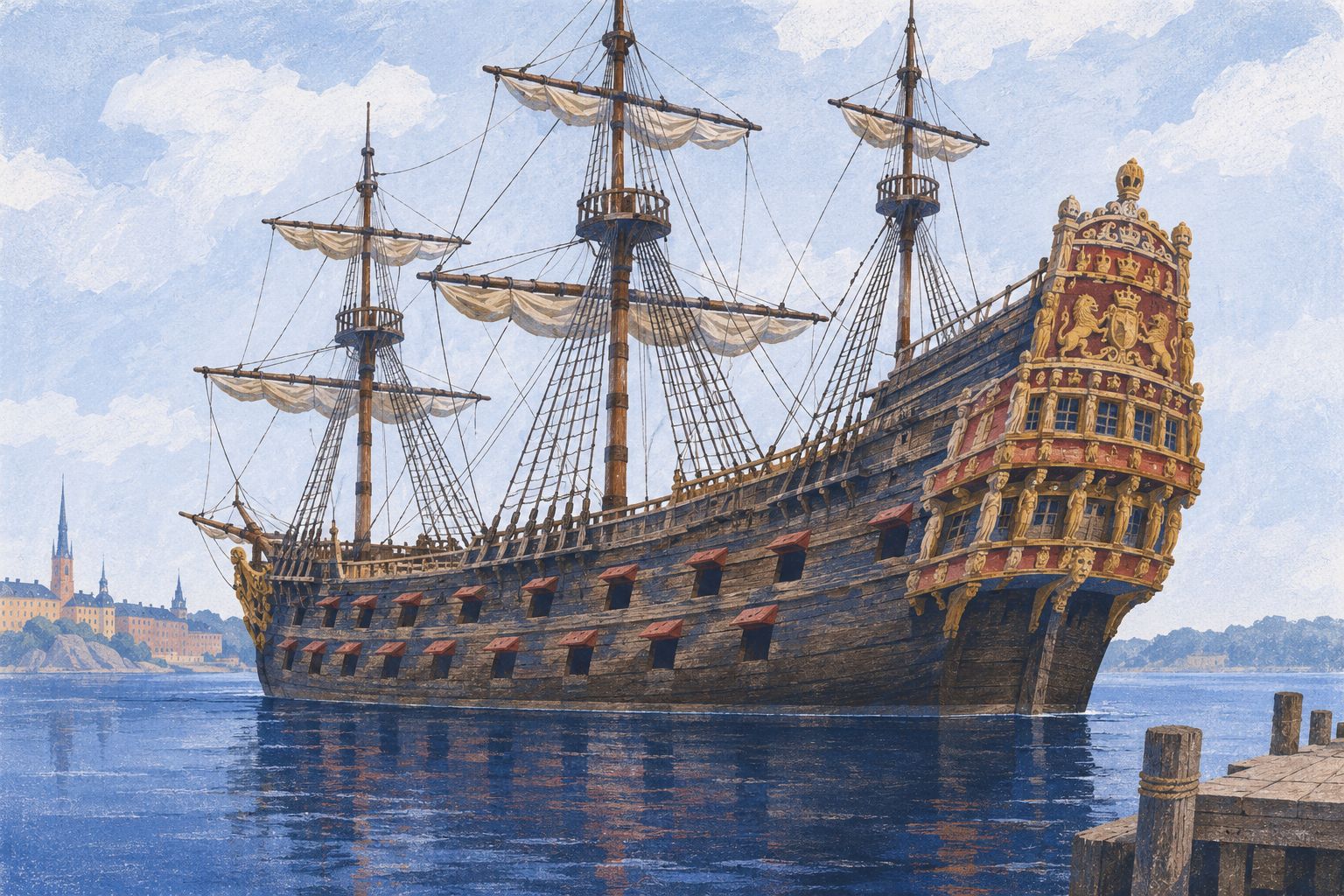
Thirty men ran across Vasa’s upper deck. The new warship rolled. They crossed again, and the movement grew worse.
Vice Admiral Klas Fleming ordered them to stop. This was a demonstration beside the quay, before the maiden voyage. It had become dangerous enough to raise the fear that the ship might capsize where she lay.
The demonstration ended. The preparations did not.
On August 10, 1628, Vasa left Stockholm on her first voyage. Within minutes of setting sail, water entered through the lower gunports and she sank in the harbor. People lost their lives before the warship had fought a battle.
The surviving inquiry would uncover a warning that had reached an admiral before the departure. What had that warning been allowed to change?
An enterprise with a royal purpose
Vasa emerged from a substantial shipbuilding organization. The Stockholm navy yard brought together specialist trades, foreign expertise, imported supplies and the Crown’s military demands. Carpenters, smiths, mastmakers and riggers worked within a production system whose materials arrived from across northern Europe.
Private contractors operated the yard for the Crown. Henrik Hybertsson, a Dutch master shipwright, and his business partner Arendt de Groote held the contract from 1626. They had to obtain materials, recruit craftsmen, maintain existing ships and build new ones.
The work was divided, but its result had to function as a whole. A sound contract, accomplished timber work and properly secured guns could each satisfy a particular responsibility. A warship still had to remain upright with its intended load.
The ship also embodied a developing military ambition. Gustav II Adolf favored powerful artillery at sea. Vasa carried 64 cannon when she sailed, within a navy still debating the relative importance of gunfire and boarding an enemy ship.
Her size and armament made her a formidable undertaking. They also made the question of stability inseparable from the very capability she was meant to deliver.
A reputation meets a particular hull
Hybertsson became too ill to supervise construction and handed the work to Hein Jakobsson. By the time Vasa sailed, the original designer was dead. Building continued through a change of hands, and the ship was launched in 1627 before further fitting out.
The Vasa Museum describes Hybertsson as an experienced shipwright with successful ships behind him. Yet this vessel introduced new demands of scale and armament. Designers lacked the mathematical tools later naval architects would use to predict stability. Experience carried much of the burden.
That made experience valuable. It also made the behavior of the actual ship especially important.
In the surviving September inquest testimony, translated by the museum’s research director Fred Hocker, the master, Jöran Matsson, described concern about the ballast and the height of the gunports above water. He also recalled Fleming reassuring him by pointing to the shipwright’s previous good ships.
The reassurance answered a question about the builder’s record. The concern concerned this hull, carrying this weight, with these openings near the water.
PCOCI’s Credibility principle turns on warranted confidence in judgment, competence and consistency. Previous accomplishment supplies relevant evidence. When present conditions raise a serious problem, credibility also requires a judgment that addresses it. Asking a reputation to settle the matter leaves the current evidence unanswered.
The issue was becoming observable. Captain Söfring Hansson arranged for Fleming to witness the rolling demonstration. Thirty men could generate enough movement for the admiral to stop them.
No calculation of the exact wind required to capsize Vasa was needed to establish that something important remained unresolved.
Stopping the demonstration
The order to halt was sensible within its immediate scope. Continuing might have lost the ship at the quay.
But the demonstration concerned whether the vessel could safely perform beyond the quay. Halting the activity removed an immediate source of danger while leaving the underlying question alive.
That distinction is easy for an organization to lose. A test can be interrupted, a troublesome operation suspended, or an adverse result taken off the immediate agenda. Each action changes what people are doing. The larger undertaking may continue with its central assumption intact.
Vasa’s experience makes the boundary unusually clear. The admiral could stop men running across a deck. The ship subsequently departed without the stability problem being resolved.
This was a failure to carry the implication of the warning into the outcome that mattered. A successful demonstration was never the purpose. A usable warship was.
A short voyage, a larger failure
Vasa’s maiden voyage began in front of spectators, with some members of the crew’s families aboard. She was to join the fleet beyond Stockholm, where her military service would begin.
Four sails were set. A gust made the ship heel, and she recovered. A later gust pushed her far enough for water to pour through the open lower gunports. Orders to release the sails and close the ports came too late to prevent the loss.
The Council of State wrote to the king on August 12. Its report described the departure and sinking, but said the cause was not yet established. The Council promised fuller information after questioning those involved and consulting knowledgeable seamen.
That immediate letter matters because the disaster had not arrived with its explanation attached. Officials had to distinguish what had happened from why it had happened.
The museum’s account identifies a ship too heavily built above the waterline for the hull beneath it. Adding ballast presented its own constraint: lowering the ship brought the gunports closer to the water. The danger could not be understood as a simple shortage of effort by the people loading her.
Responsibility comes under examination
The inquest convened at Stockholm’s royal palace on September 5. It questioned officers, craftsmen and contractors about the loss.
Their answers show how an integrated failure could be divided into defensible pieces. A lieutenant referred to his rigging duties and lack of knowledge about the ballast. Builders invoked the specifications they had received and the king’s approval. Matsson defended how he had stowed the ballast.
The prosecutor pressed beyond individual tasks toward whether the finished vessel had the proportions it needed. The distinction was fundamental: conformity to an instruction could coexist with failure of the undertaking.
The transcript survives only in part. It records testimony given after a catastrophe, when participants were being called to account. It is not a complete account of every earlier decision.
The museum’s historical account nevertheless identifies a striking boundary to the scrutiny. Fleming, who had witnessed the demonstration, was not questioned. No one was officially blamed or punished.
Punishment by itself would not have explained the design or repaired the decision process. The more consequential question was whether the exercise of authority could be examined as rigorously as the conduct of those working beneath it.
What meaningful Control must carry
In the PCOCI progression, Credibility enables Ownership, and Ownership enables meaningful Control. Control creates conditions for sustained Improvement by making authority explicit, bounded and accountable. The ability to issue an order is one part of that structure.
Vasa’s story exposes a failure within the path toward Improvement. There was a warning, an intervention and a departure. The intervention protected the ship from the immediate test without securing a sound basis for proceeding. Later scrutiny did not reach everyone whose authority had touched the problem.
For an organization, the practical issue is the status of an unresolved finding. Someone must carry responsibility for its consequences. A decision-maker must determine what permits continuation, whose judgment is needed and where disagreement can be reviewed. The authority to proceed must remain answerable for the grounds on which it acts.
Those arrangements cannot supply a better hull design. They can create the conditions in which a dangerous one is examined before people depend on it.
Vasa never delivered the naval capability for which she had been built. The leadership insight lies in the passage that failed: from experience to credible judgment about present conditions, and from the power to direct work to accountable Control of its consequences.