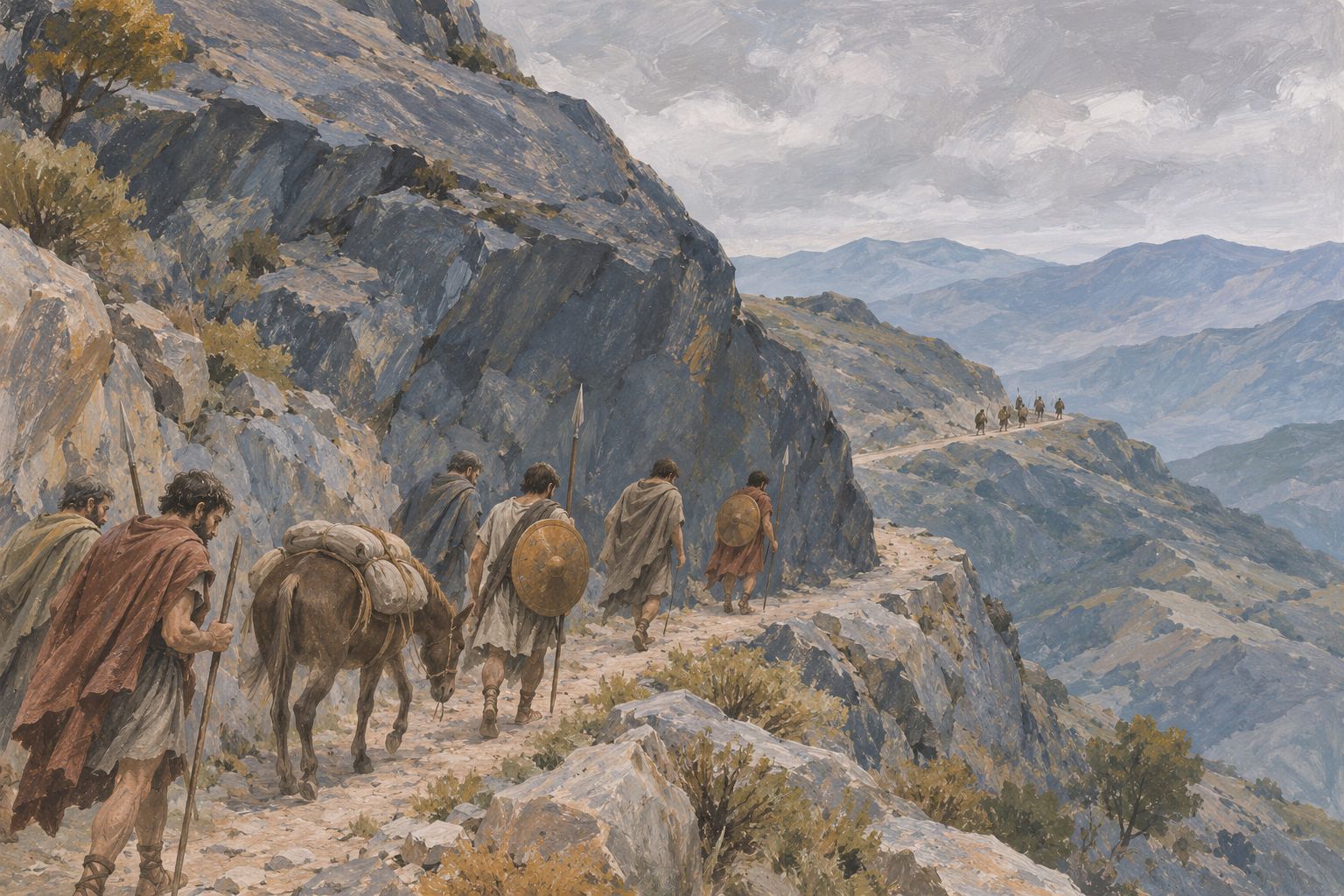
Xenophon sent word along the column: the front needed to wait. At the rear, men were fighting off attackers on a narrow mountain road. The reply came back from Cheirisophus, leading ahead: keep up.
They belonged to the same retreating army. They were trying to survive the same journey. Yet the two commanders were responding to dangers that the other could not adequately see.
By the time they could confront one another, two men at the rear were dead.
The army after its purpose collapsed
The march had begun as a different enterprise. In 401 BCE, Greek mercenaries accompanied Cyrus the Younger in his attempt to take the Persian throne from his brother, Artaxerxes II. Cyrus died at Cunaxa. The campaign’s purpose died with him, leaving the Greeks deep inside the territory through which they would have to retreat.
After several of their commanders were seized during negotiations, the surviving officers chose replacements. Xenophon, an Athenian who had joined through his connection with Proxenus, became one of them. The soldiers then assembled to consider how to proceed.
Their arrangements distributed responsibility around a marching formation. Cheirisophus would lead; other generals would take the flanks; Xenophon and Timasion would command the rear. Baggage and the people accompanying the soldiers needed protection within it.
That arrangement created different encounters with the same terrain. The front discovered what lay ahead. The rear dealt with what followed, including the consequences of the column’s movement. An instruction to accelerate would travel through men whose ability to move depended on fighting, carrying and keeping others alive.
Xenophon later made the retreat into the Anabasis. He writes about himself in the third person, but he was a participant with a reputation to defend. His account preserves both practical detail and a carefully presented version of his own leadership. Its speeches are his literary account of the exchanges, rather than a transcript recovered from the road.
An order with another danger behind it
Before the mountain confrontation, the army had already encountered a similar separation of knowledge.
In Book 3, Cheirisophus summons Xenophon forward with light infantry because enemy troops hold a position above the route. Xenophon rides ahead, but leaves those troops behind. He can see another enemy force approaching the rear and will not expose it.
The discussion changes the available plan. The two consider taking higher ground above the blocking force. Xenophon goes with troops supplied from the front, avoiding the delay of bringing men all the way up from behind. Cheirisophus stays with the main body.
The adjustment begins with information that the original instruction did not contain. The requested troops have a job where they already are. Once that becomes part of the discussion, a different allocation becomes possible.
This is a demanding form of attention. A leader has to understand why a reasonable instruction looks different where it will be carried out. The person receiving it may know something essential about the consequences of compliance.
The later episode in the Carduchian mountains is harsher. In Book 4, a storm and inadequate provisions press the army onward. Attackers repeatedly close on its rear with bows and slings. Xenophon’s men turn to resist, then try to resume the march. He asks Cheirisophus to slow down.
Cheirisophus, who ordinarily waits when such messages arrive, continues quickly. Xenophon reports that there was no time to go forward and discover why. At the next halt he reproaches the Spartan commander for making the rear fight while trying to escape. Two soldiers have been killed, and their bodies left behind.
Cheirisophus directs his attention to the road ahead. An enemy force has occupied the pass. He had hurried in the hope of reaching it first, because his guides knew no other route.
The danger at the front is real within the account. So is the danger at the rear. Knowing either one fully does not, by itself, resolve what the whole army should do.
The passage then takes a brutal turn. The Greeks question two captured men about an alternative route. They kill the first when he gives no useful answer; the second offers to guide them. The march’s continuation belongs to that history of coercion as well as to its commanders’ ingenuity. The people through whose country the army passed bore consequences outside the Greeks’ account of their own survival.
Finding out what delay means
In Armenia, the distance between the leading troops and the people struggling behind becomes visible in another way.
Men collapse during a march through snow. Xenophon says he initially does not understand the cause. Someone familiar with the condition identifies hunger-faintness. He then finds food among the baggage and distributes it, using stronger men to carry it along the line. Those who eat can get up and continue.
His position at the rear brings him into contact with the failure to move. Another person’s knowledge supplies an explanation. Access to provisions and people able to distribute them makes a response possible. Each contributes something the others cannot provide alone.
Conditions remain desperate. Some soldiers reach shelter with Cheirisophus; others spend the night outside. Xenophon describes sick men unable to continue, troops lying along the road and an inquiry sent forward to discover what is blocking movement. His own party also has to spend the night without food or fire.
Toward morning, Cheirisophus sends men from the village to find out how the rear is faring. They take over carrying the sick, and Xenophon’s party reaches camp.
The movement back through the column matters. People who have reached shelter return to the conditions of those who have not. Their inquiry becomes practical help. The arrival of the front ceases to stand for the condition of everyone.
Presence across the work
The historian Andrew Dalby, examining the army’s social organization, draws attention to the limits that geography placed on observation. Broken terrain, darkness and weather could keep the rear from knowing what was happening ahead. A hierarchy on its own could not remove that separation.
In PCOCI, Presence means sustained contact with the work and the people carrying it. The retreat gives that principle a particular edge. Both commanders are deeply involved. Both face immediate consequences. Their involvement still gives each an incomplete picture.
Presence therefore needs a reach beyond personal immersion. It includes people able to report what an order will encounter, exchanges that carry reasons as well as instructions, and inquiry into parts of the work whose difficulty is easy to mistake for delay.
For an organization, the same distinction becomes important wherever one team’s progress depends on another’s capacity. A leading team may have completed its part while the people handling exceptions, recovery or support remain under pressure. A completion report cannot describe those conditions unless the organization makes room to discover them.
That is a question about the quality of contact before it becomes a judgment about effort. Where has the work stopped? What is holding it there? Who can explain the constraint? What does the proposed response require from people somewhere else?
Such understanding gives Credibility something concrete to develop from. It also informs the responsibilities and boundaries that Ownership and meaningful Control require. Sustained Improvement depends on carrying that learning into continuing work. The episodes in the Anabasis show moments of connection, costly separation and practical assistance; they leave a lasting organizational capability unestablished.
Their value is in making the distance visible. The leader nearest one danger may still need someone else to explain the next.