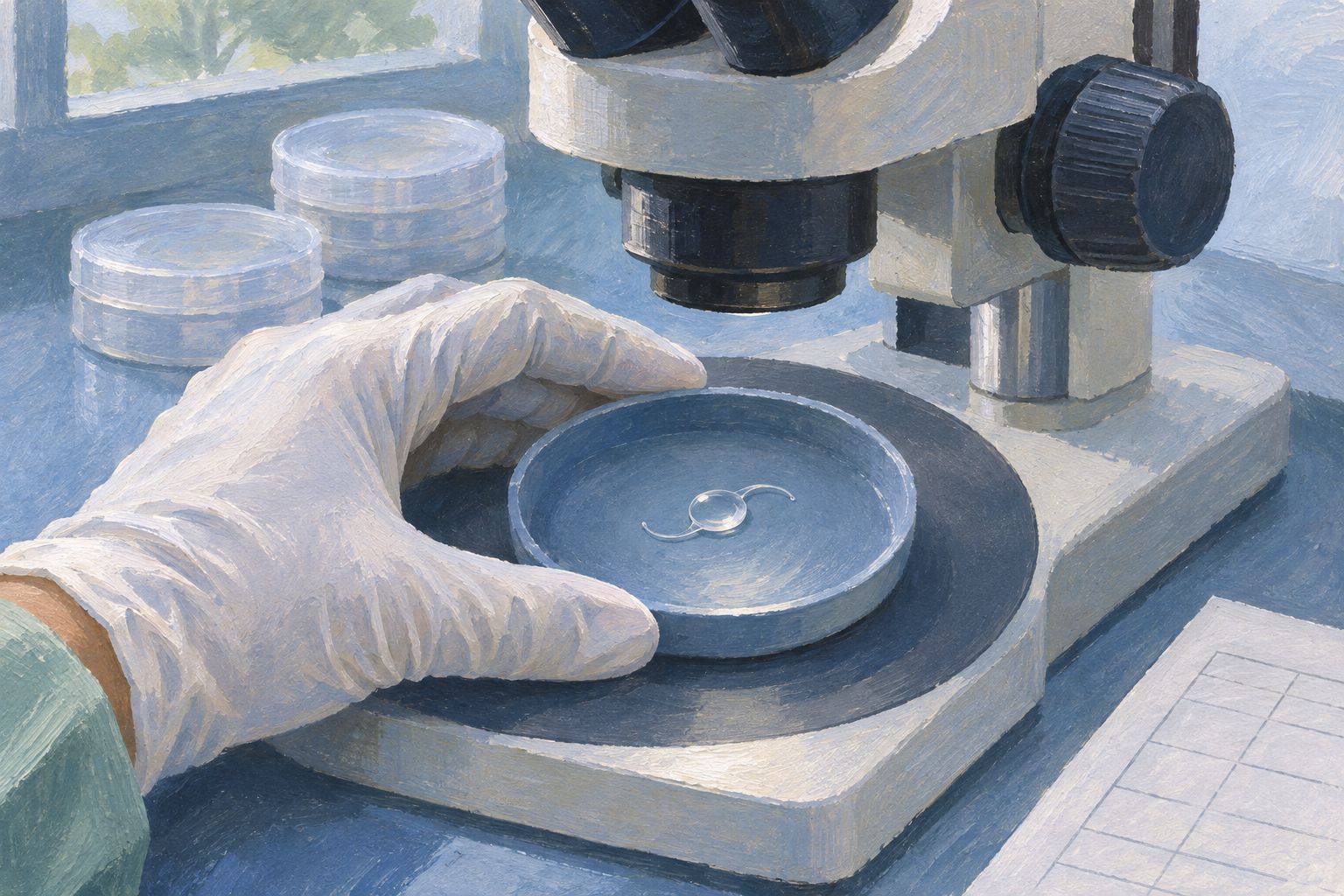
In 1988, only 4 percent of cataract operations in Aravind’s free or subsidised section used an implanted lens. In the paying section, the proportion was 41 percent. The same organization was treating the same disease, but a patient’s ability to pay still shaped the treatment available.
For G. Venkataswamy, the ophthalmologist who had founded Aravind in Madurai, that gap reached into ordinary working life. Removing a cataract could leave a person dependent on thick corrective spectacles. An implant offered a different way to restore useful vision. Its price helped keep it out of reach.
Aravind’s answer would eventually include a factory. But producing an affordable lens exposed a larger task: changing enough of the work around it for a better treatment to become an everyday possibility.
The boundary inside the mission
Aravind had begun in 1976 with an eleven-bed hospital in southern India. Its purpose was to eliminate needless blindness. The lens problem made that purpose demanding in a particular way. The organization could already provide care. It now had to decide what quality of care its mission obliged it to make possible.
Aravind’s own account describes the early 1990s debate over whether developing countries should adopt intraocular lenses when they were so expensive. Cost could be treated as a reason to postpone an advance. Aravind instead helped establish Aurolab in 1992 as a nonprofit manufacturing trust.
That choice moved the boundary of the enterprise. A hospital seeking a more affordable input was becoming connected to the capability to produce it. The question changed from what could be bought within the existing budget to what could be built so the budget ceased to exclude so many people.
This was a substantial undertaking. A clinical mission does not supply the machinery, production knowledge or disciplined inspection needed to manufacture an implant. The ambition had to survive contact with work that a hospital could not simply wish into existence.
Learning to make the lens
The 2006 research case Making Sight Affordable, coauthored by Aurolab managing director P. Balakrishnan, describes the search for production expertise. Balakrishnan worked with David Green of the Seva Foundation. A small Florida lens manufacturer eventually agreed to transfer the necessary knowledge and equipment.
Engineers learned the production system during a trial in Florida. The supplier’s staff then accompanied the equipment to India for installation and further training. Experienced hospital nurses recruited for production had also trained locally before the machinery arrived. Continuing contact with the technology provider helped the new operation improve its production process.
The transfer included ways of working as well as equipment. A machine could arrive in Madurai without its operators yet knowing how to obtain a dependable result from it. Training on both sides of the journey helped close that distance.
The MacArthur Foundation’s 2004 account of Green’s work places engineers, technical specialists, financing and distribution within the same undertaking. By then, it reported, Aurolab was producing hundreds of thousands of lenses annually on a self-sustaining basis and distributing them internationally.
The consequence was larger than a successful shipment or a promising initial batch. Production became a continuing capability, able to serve demand beyond the hospital that had helped bring it into being.
The next constraint was already waiting
Affordable supply did not equip every surgeon to perform a different operation. Aravind began its Micro Surgery Training Programme in 1993 with support from Sightsavers International. The organization was developing the ability to use the technology alongside the ability to obtain it.
The connection matters. An improvement in one part of an enterprise can leave another part carrying a demand it cannot yet meet. More available lenses create little benefit for a patient if the necessary skill remains unavailable. Training has limited reach if the materials needed to apply it remain unaffordable.
Aravind’s wider operating system also depended on trained support staff. In their 2007 case, V. Kasturi Rangan and R. D. Thulasiraj describe the preparation and diagnostic work performed by ophthalmic assistants, allowing doctors to concentrate on work requiring their clinical judgment. The organization developed its own training pipeline for those assistants.
The capacity of a surgeon was therefore partly a property of the surrounding team. Preparation, instruments and the next patient’s arrival could either support specialist work or interrupt it. Increasing throughput required attention to these relationships, with the quality of care retained as a governing purpose.
The lens factory made one important constraint changeable. It did not make the other constraints disappear. Leadership had to keep the work connected as the possibilities expanded.
Results had to remain visible
Aravind’s 2008 clinical account reports that outcomes and surgical complications had been monitored since 1991 using evolving software. Its review included vision, infections, complications and repeat operations. The learning system preceded Aurolab and continued as treatment changed.
By 1998, 88 percent of cataract operations in the free or subsidised section used an implant, compared with 4 percent a decade earlier. That change records a substantial expansion in access to the technology within Aravind. It also made continuing examination of the care being delivered consequential at a much larger scale.
An operation count answers a necessary question about reach. It leaves open what happened to the person. An organization that increases the first number needs a dependable way to keep asking the second question.
Outcome review makes performance available for examination after the immediate work has been completed. Patterns can be seen across cases that would otherwise remain separate. The organization gains a basis for changing a process, developing a skill or investigating an unexpected result.
This is a demanding form of continuity. Success creates more work to understand. A capability to learn protects the organization from treating yesterday’s advance as sufficient evidence about today’s performance.
The price the patient still pays
The wider cost of care remained important. In a 2014 account, Aravind leaders described designing services around travel, repeated visits and the expense of an accompanying person. Transportation for outreach patients and arrangements that reduced unnecessary journeys addressed burdens outside the surgical bill.
They also stressed that replication had to respond to local conditions. Southern India’s population density, roads, transport and middle class helped shape Aravind’s system. Another setting would need arrangements suited to its own people and resources.
These observations extend the meaning of affordability. The institution’s cost of providing a service and a person’s ability to use it are connected, but they are different questions. A lower bill can coexist with a journey that remains difficult to make.
For a leader, that distinction changes where the work ends. Performance cannot be understood entirely from inside the institution’s accounts. The circumstances of the person trying to obtain the service remain part of the problem the organization has chosen to solve.
A capability that can keep advancing
Aravind’s story gives PCOCI’s Improvement a concrete organizational form. Manufacturing altered access to an essential input. Training developed the people able to use it. Outcome review sustained the capacity to examine what the combined work was delivering.
The advance resided in those relationships. It could be repeated because skills, supplies and learning supported one another. It could extend because the organization had developed capabilities that reached beyond an individual operation.
This is the leadership significance of the lens. A better option became the starting point for a more capable institution. Improvement asked that institution to become better at making its promise usable, and better at discovering what still stood in the way.